

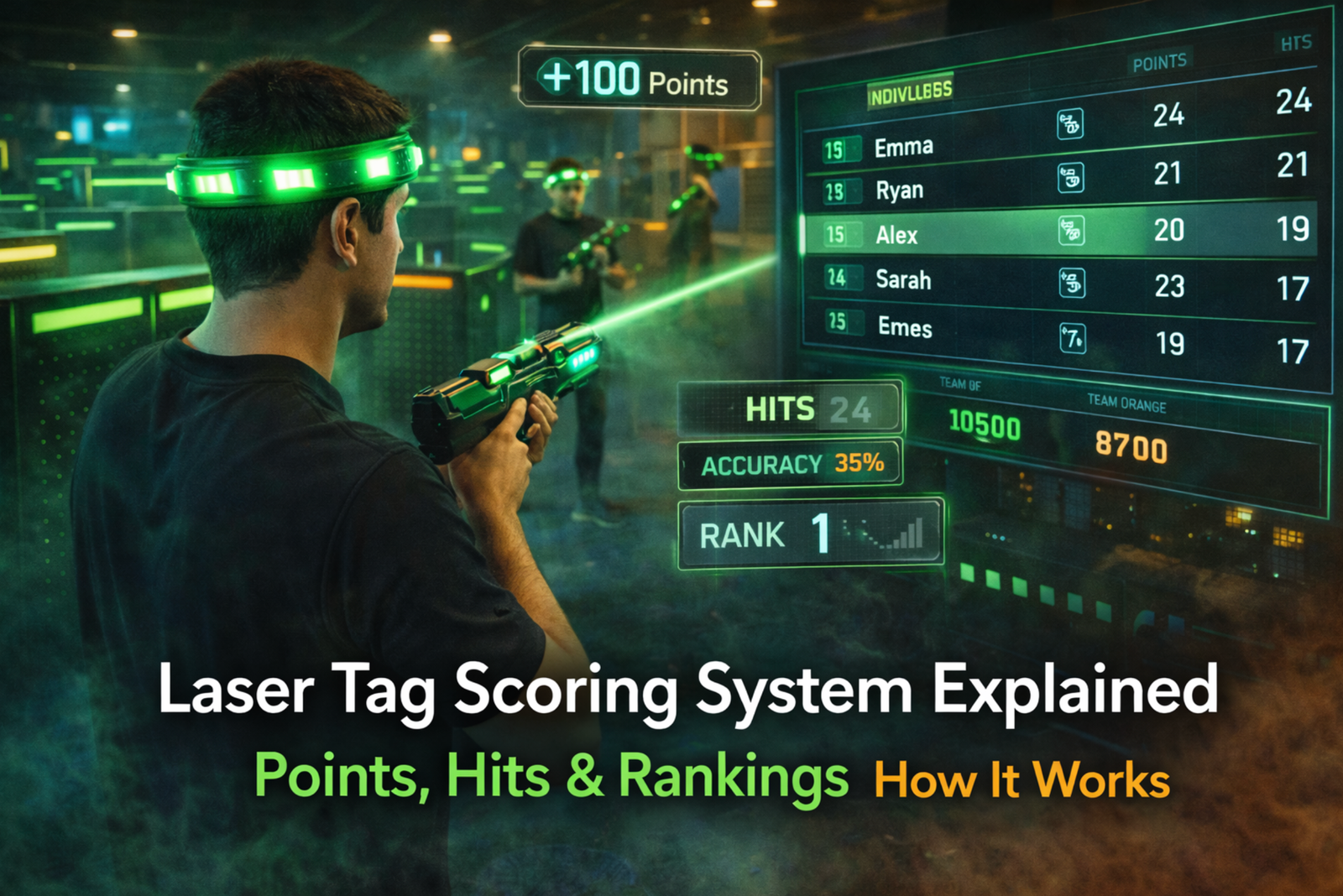
Laser Tag Scoring System Explained. How Points, Hits, and Rankings Work
If you’ve ever finished a laser tag game and stared at the scoreboard wondering how the final numbers were calculated, you’re not alone. The laser tag scoring system works behind the scenes throughout the match, tracking every hit, miss, and action in real time. Understanding how scoring works helps players play smarter, set better strategies, and enjoy the game more.
This guide breaks down how laser tag scoring systems work, what earns points, and how rankings are determined at the end of a match.
The Basics of Laser Tag Scoring
At its core, laser tag scoring is based on successful hits. When a player’s infrared beam reaches an opponent’s sensor, the system records that interaction instantly.
A standard scoring system tracks:
- Hits landed on opponents
- Times a player is hit
- Total points earned
- Accuracy or efficiency
- Time spent active during the match
All data is collected automatically by the system, removing human error and keeping games fair.
How Players Earn Points
While scoring varies slightly by venue and game mode, most systems follow similar logic.
Common ways to earn points include:
- Tagging an opposing player
- Tagging specific target zones
- Completing objectives such as defending or capturing a base
- Surviving longer without being tagged
Some modes award bonus points for streaks, accuracy, or teamwork.
What Happens When You Get Tagged
Being tagged does not end your game, but it does affect scoring.
Typically:
- Your sensors deactivate for a few seconds
- You cannot score during that time
- Your hit count increases
- The opponent earns points
This short downtime encourages players to reposition instead of rushing back into action.
Accuracy and Shot Tracking
Many modern laser tag systems go beyond basic hit counting.
They also track:
- Shots fired
- Shots that hit a sensor
- Overall accuracy percentage
Accuracy matters because players who shoot carefully often score higher than those who fire constantly without aiming.
Team-Based Scoring Systems
In team modes, individual scores contribute to a team total.
Team scoring may include:
- Combined hit points
- Objective completion points
- Time-based control scores
Even if a player is not leading individually, strong teamwork can secure a team victory.
Objective-Based Scoring
Some game modes introduce objectives beyond tagging players.
Examples include:
- Holding a zone for a set time
- Capturing a flag or base
- Protecting a designated player
In these modes, objective points often outweigh individual hit points, encouraging strategy and cooperation.
End-of-Game Rankings and Scoreboards
When the match ends, the system compiles all collected data into a scoreboard.
Scoreboards often display:
- Player rankings
- Total points
- Accuracy percentages
- Hit and death counts
- Team results
These summaries add excitement and give players a clear picture of how they performed.
At Blackout Field, modern scoring systems provide detailed post-game stats, helping players understand their performance and improve in future rounds.
How Scoring Affects Strategy
Once you understand scoring, gameplay changes.
Smart players:
- Focus on accuracy instead of rapid firing
- Avoid unnecessary hits that increase downtime
- Prioritize objectives in team modes
- Protect teammates to maintain team scores
Winning often comes from understanding the scoring system, not just movement speed.
Common Scoring Myths
Some misconceptions players have include:
- Shooting more always scores more
- Running faster earns extra points
- Getting tagged frequently does not matter
In reality, controlled movement, smart positioning, and accuracy matter far more.
Frequently Asked Questions
Do different arenas use different scoring systems?
Yes. While the basics are similar, point values and bonus rules can vary.
Can two players have the same score?
Yes. Ties can happen, especially in shorter matches.
Is accuracy more important than speed?
In most systems, accuracy has a bigger impact on final rankings.
Are scores saved after the game?
Some venues allow players to view or print scorecards, while others display results briefly on screen.
Final Thoughts
The laser tag scoring system is designed to reward smart play, teamwork, and accuracy rather than chaos. Once you understand how points are earned and tracked, every decision in the arena feels more meaningful.
Instead of firing blindly, aim with purpose. Instead of rushing forward, think strategically. When you play with the scoring system in mind, laser tag becomes not just a game of movement, but a game of skill and strategy.


 English
  Arabic