

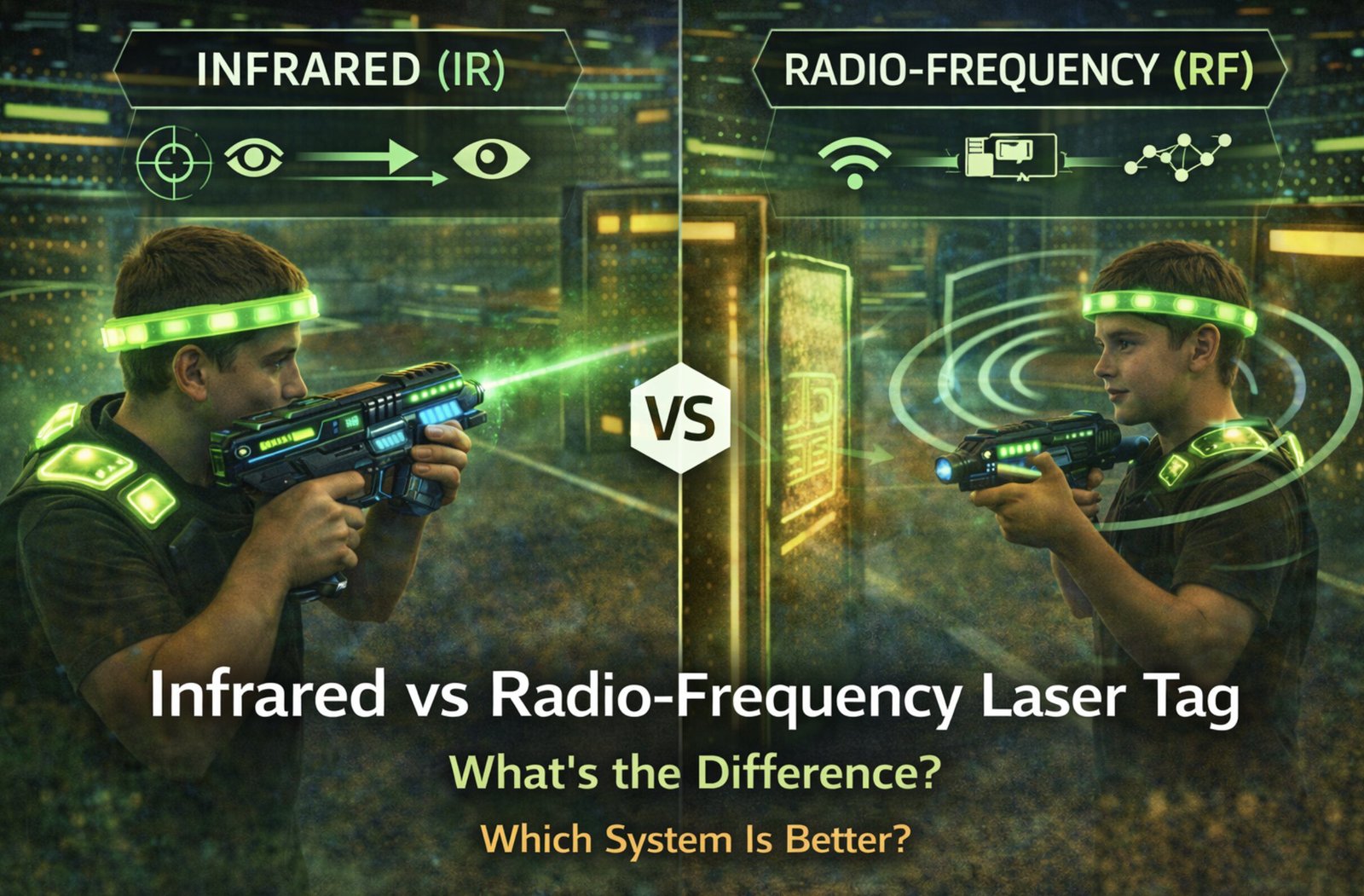
Infrared vs Radio-Frequency Laser Tag Systems. What’s the Difference and Which Is Better?
Laser tag feels simple on the surface, but behind every match is a technology system deciding how shots travel, how hits register, and how fair the game feels. The two most common systems you’ll hear about are infrared and radio-frequency (RF) laser tag. Each works differently and creates a very different style of gameplay.
This guide explains infrared vs radio-frequency laser tag systems, how they work, their pros and cons, and which one is usually better for most players.What Is an Infrared Laser Tag System?
Infrared laser tag is the most widely used system in indoor arenas. Despite the name, it does not use real lasers.
Infrared systems work by:
- Sending an invisible infrared light signal from the gun
- Detecting that signal with sensors on a vest or headband
- Registering a hit only when there is clear line of sight
Infrared behaves like light. If something blocks the path, the hit does not register.
How Infrared Laser Tag Feels to Play
Infrared systems reward accuracy and smart positioning.
Gameplay characteristics include:
- Clear aiming is required
- Cover and angles matter
- Movement and timing are important
- Hits feel fair and skill-based
This makes infrared laser tag ideal for competitive play, beginners, and mixed-age groups.
What Is Radio-Frequency Laser Tag?
Radio-frequency laser tag systems use RF signals instead of light. These signals can pass through objects like walls, obstacles, and sometimes even players.
RF systems work by:
- Sending a radio signal from the gun
- Allowing hits to register without direct line of sight
- Detecting players within a defined range
RF systems are more common in outdoor or large-area scenarios.
How Radio-Frequency Laser Tag Feels to Play
RF gameplay feels very different from infrared.
Common characteristics include:
- Less precise aiming
- More emphasis on proximity than accuracy
- Hits may register through obstacles
- Faster, less tactical encounters
Some players enjoy the arcade-style simplicity, while others find it less realistic.
Infrared vs RF. Key Differences
Line of Sight
Infrared requires direct line of sight. RF does not.
Accuracy
Infrared rewards careful aiming. RF prioritizes range and proximity.
Use of Cover
Infrared makes cover meaningful. RF reduces the value of hiding.
Arena Type
Infrared is best for indoor arenas. RF works better outdoors or in open spaces.
Skill Level
Infrared supports skill progression. RF is more casual and forgiving.
Which System Is Safer?
Both systems are safe and non-contact, but infrared is more controlled.
Infrared systems:
- Are widely used in supervised indoor venues
- Follow strict safety standards
- Use low-power, eye-safe technology
RF systems are also safe but are typically used in specialized environments rather than family entertainment centers.
Why Most Indoor Arenas Choose Infrared
Most professional indoor laser tag arenas use infrared systems because they deliver consistency and fairness.
Infrared systems offer:
- Predictable hit detection
- Balanced competition
- Clear scoring logic
- Better gameplay for all ages
In Dammam and nearby Khobar, indoor arenas almost always rely on infrared technology for these reasons.
At Blackout Field, advanced infrared systems paired with lightweight headband sensors ensure accurate hits, fair scoring, and skill-based gameplay without bulky equipment.
When RF Laser Tag Makes Sense
RF systems can still be useful in specific cases.
They work well for:
- Outdoor military-style simulations
- Large open fields
- Casual group play without complex rules
They are less common in commercial indoor venues.
Which System Is Better for Beginners?
Infrared systems are usually better for beginners.
Why:
- Clear cause-and-effect gameplay
- Easier to understand rules
- Less confusion about how hits register
- Better learning curve
Beginners feel more in control and less frustrated.
Frequently Asked Questions
Does infrared laser tag hurt?
No. Infrared uses invisible light and has no physical impact.
Can RF laser tag shoot through walls?
Yes. That is one of its defining features.
Which system is more competitive?
Infrared systems are far more competitive and skill-based.
Do modern arenas still use RF systems?
Most modern indoor arenas use infrared rather than RF.
Final Thoughts
Infrared and radio-frequency laser tag systems create very different experiences. Infrared focuses on accuracy, awareness, and strategy, while RF emphasizes proximity and speed with fewer tactical elements.
For indoor arenas, family groups, competitive play, and fair scoring, infrared systems are usually the better choice. They make every hit feel earned and every win feel deserved.


 English
  Arabic