

The History of Laser Tag. How the Game Evolved Into Modern Entertainment
Laser tag feels futuristic, but its story goes back further than most people realize. What started as a military training concept slowly evolved into one of the most popular indoor group games in the world. Understanding the history of laser tag gives you a new appreciation for the technology, the rules, and the fast-paced experience players enjoy today.
This article walks through the history of laser tag, from its early inspiration to the modern systems used in arenas today.
The Military Origins of Laser Tag
The roots of laser tag trace back to military training in the 1960s and 1970s. Armed forces were looking for safe ways to train soldiers in combat scenarios without live ammunition.
This led to the development of laser-based training systems that used infrared light to simulate gunfire and detect hits on sensors worn by soldiers. These systems focused on accuracy, movement, and teamwork, all principles that still exist in laser tag today.
The idea of tagging an opponent electronically instead of physically was the foundation of the game.
From Training Tool to Science Fiction Inspiration
In the late 1970s, popular science fiction films and television shows sparked public interest in futuristic combat. This cultural shift helped transform military-style infrared games into something that could be enjoyed recreationally.
Early concepts combined:
- Infrared targeting systems
- Wearable sensors
- Sci-fi themed weapons and environments
The goal was no longer training but entertainment.
The First Commercial Laser Tag Games
Laser tag entered the public space in the early 1980s. One of the earliest and most influential systems was Photon, introduced in 1984. Dedicated laser tag arenas opened in major cities, featuring dark rooms, glowing obstacles, and electronic scoring.
These early arenas established many standards still used today:
- Team-based gameplay
- Timed matches
- Score tracking
- Neon-lit environments
Although the equipment was bulky by modern standards, the experience quickly became popular among teens and young adults.
The Rise of Home Laser Tag
During the late 1980s and 1990s, laser tag moved from arenas into homes. Toy manufacturers released handheld laser tag sets that allowed kids to play outdoors or indoors with simplified rules.
Home versions helped laser tag grow globally, making the concept familiar even to people who had never visited a professional arena.
Technological Advances in the 2000s
As electronics became smaller and smarter, laser tag equipment improved dramatically.
Key developments included:
- Lighter guns and sensors
- Wireless communication
- Digital scoring systems
- Multiple game modes
- Improved hit detection accuracy
These upgrades made laser tag faster, more reliable, and more immersive.
Modern Laser Tag Arenas
Today’s laser tag arenas focus on experience as much as gameplay. Modern systems often use advanced sensors, customizable game modes, and real-time scoring displays.
Many venues now offer:
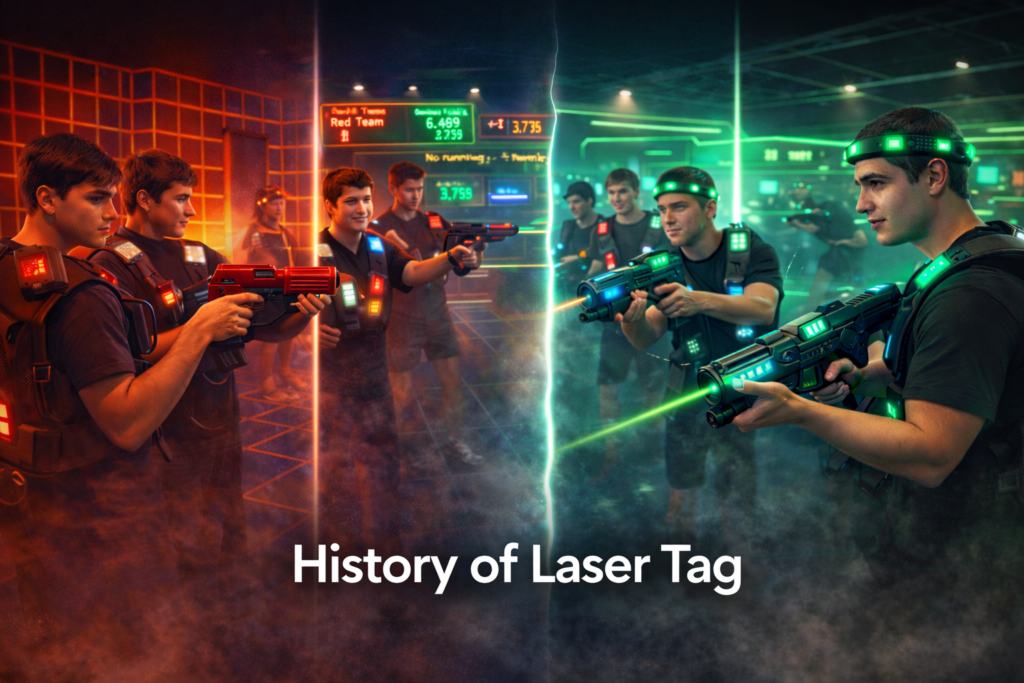
- Headband sensors instead of bulky vests
- Themed arenas with lighting and sound effects
- Structured tournaments and group events
- Corporate team building and birthday packages
At Blackout Field, modern laser tag reflects decades of innovation, combining lightweight equipment with fast-paced gameplay designed for groups of all ages.
Why Laser Tag Has Stood the Test of Time
Laser tag continues to thrive because it adapts easily to new technology and social trends.
It remains popular because it is:
- Safe and non-contact
- Easy to learn
- Suitable for mixed ages
- Competitive yet friendly
- Ideal for group activities
Few games manage to balance excitement, accessibility, and safety as well as laser tag.
Frequently Asked Questions
When was laser tag invented?
Laser tag emerged in the early 1980s, inspired by earlier military training systems that used infrared technology.
Was laser tag always meant for entertainment?
No. The original technology was developed for military simulation and training before being adapted for recreational use.
How has laser tag changed over time?
Equipment has become lighter, more accurate, and more customizable, while arenas have become more immersive.
Is modern laser tag very different from early versions?
Yes. Modern systems offer better scoring, more game modes, and more comfortable equipment compared to early bulky setups.
Final Thoughts
Laser tag’s journey from military training tool to global entertainment phenomenon is a story of innovation and creativity. Each generation of technology made the game safer, smarter, and more engaging. Today, when players step into a laser tag arena, they’re experiencing decades of evolution packed into a few fast-paced minutes of fun.
Knowing the history adds depth to every match and highlights why laser tag remains one of the most enduring group activities in the world.


 English
  Arabic