

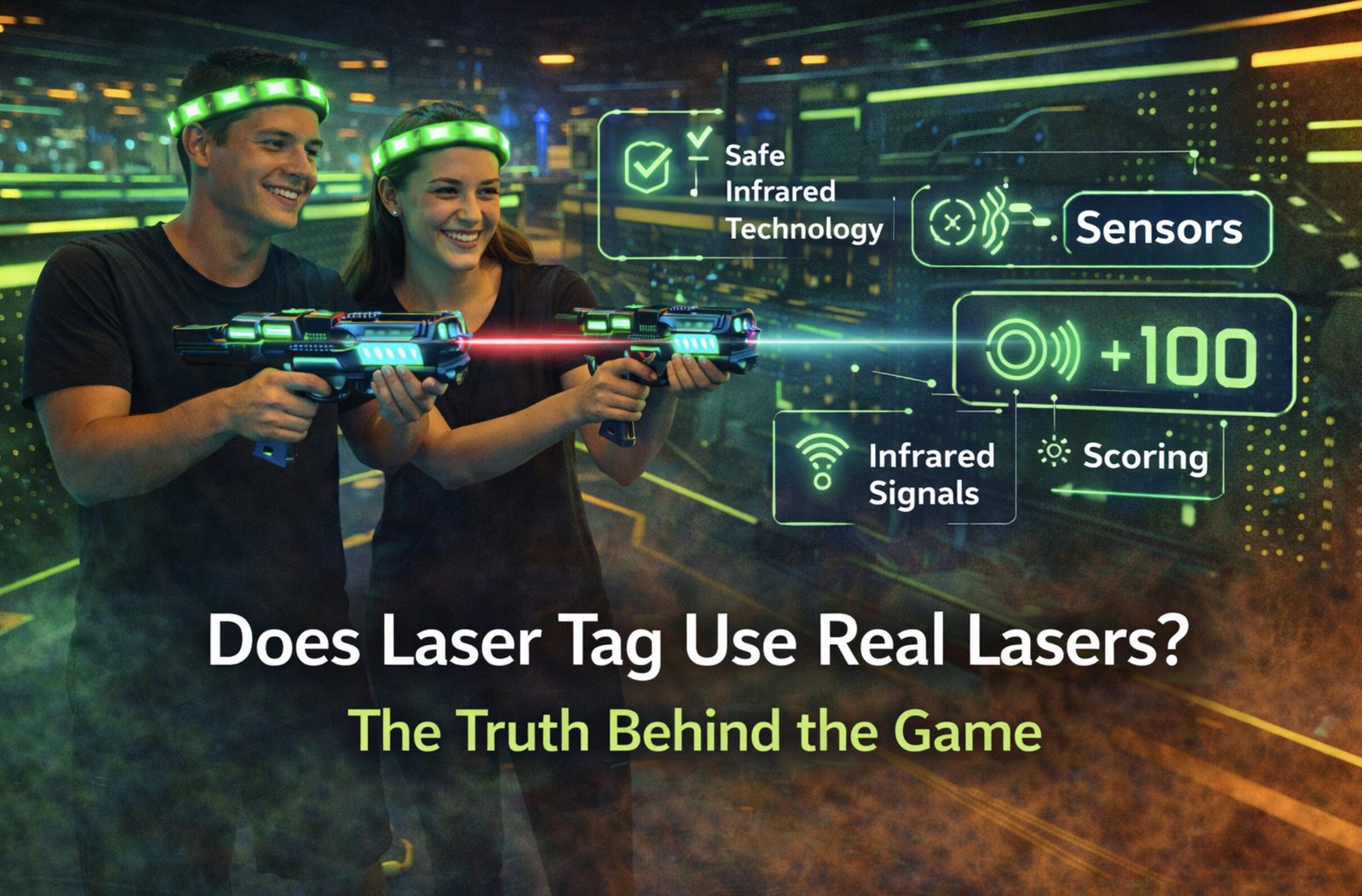
Does Laser Tag Use Real Lasers? The Truth Behind the Game
If you’ve never played laser tag before, the name alone can raise a few questions. “Laser” sounds intense, and it’s natural to wonder whether the game involves real lasers or any kind of risk. Parents often ask this before letting their kids play, and first-time players are simply curious about how the technology works.
The short answer is no, laser tag does not use real lasers. Let’s break down what it actually uses, why it’s safe, and how the system works.Why Laser Tag Doesn’t Use Real Lasers
Real lasers can be harmful, especially to the eyes. Because laser tag is designed as a safe, family-friendly activity, real laser beams are never used.
Instead, laser tag relies on infrared light, which is completely invisible and harmless. Infrared light is the same type of technology used in everyday devices like TV remote controls.
This choice makes laser tag safe for kids, teens, and adults.
What Technology Does Laser Tag Actually Use?
Laser tag systems use three main components:
- Infrared emitters inside the laser tag guns
- Sensors on vests or headbands worn by players
- A central scoring system that tracks hits and points
When you pull the trigger, the gun sends out an infrared signal. If that signal reaches another player’s sensor, it registers as a hit. There is no beam you can see and no physical impact at all.
Is Infrared Light Safe?
Yes. Infrared light used in laser tag is low power and non-ionizing, which means it does not damage skin or eyes.
Key safety points include:
- No heat or energy transfer
- No visible light aimed at eyes
- No physical contact
- Strict safety standards in commercial systems
This is why laser tag is often recommended as a safe alternative to activities like paintball or airsoft.
Why Do Laser Tag Guns Look Like They Shoot Lasers?
The visual effects are for fun, not function.
Laser tag guns often include:
- LED lights
- Sound effects
- Glowing indicators
These features help players know when they’ve fired or been hit, but they are not actual lasers.
How Hits Are Detected Without Lasers
Sensors are tuned to detect specific infrared codes sent by the guns.
When a hit occurs:
- The sensor receives the infrared signal
- The system verifies it as a valid tag
- Lights and sounds activate
- The score updates instantly
Everything happens electronically, without any physical beam or impact.
Is Laser Tag Safe for Kids?
Yes. Because it does not use real lasers or projectiles, laser tag is considered one of the safest action games available.
It is:
- Non-contact
- Supervised
- Suitable for mixed ages
- Free from protective gear requirements
That’s why many families in Dammam and nearby Khobar choose laser tag for birthdays and group outings.
At Blackout Field, games use modern infrared systems with lightweight sensors, ensuring a comfortable and safe experience for players of all ages.
Common Myths About Laser Tag
- Myth: Laser tag uses real laser beams
- Truth: It uses invisible infrared light
- Myth: Laser tag can hurt your eyes
- Truth: Infrared systems are eye-safe
- Myth: You feel pain when tagged
- Truth: Tags are detected electronically, with no physical sensation
Understanding these facts helps players relax and enjoy the game.
Frequently Asked Questions
Can laser tag damage eyesight?
No. Laser tag does not use real lasers and poses no risk to eyesight.
Why is it still called “laser” tag?
The name comes from early science-fiction inspiration, not the actual technology.
Is laser tag safer than paintball?
Yes. Laser tag involves no physical impact and requires no protective gear.
Can adults enjoy laser tag too?
Absolutely. Laser tag is popular among adults for stress relief and group fun.
Final Thoughts
Laser tag may sound futuristic, but the technology behind it is simple, safe, and well-tested. It does not use real lasers, and there is no risk of burns, eye damage, or physical injury from the equipment.
Once you understand how it works, you can step into the arena with confidence and focus on what really matters. Strategy, teamwork, and having fun.


 English
  Arabic